Three High-Stakes Senate Primaries Where Independents Can Swing the Outcome

Updated: Jul 20
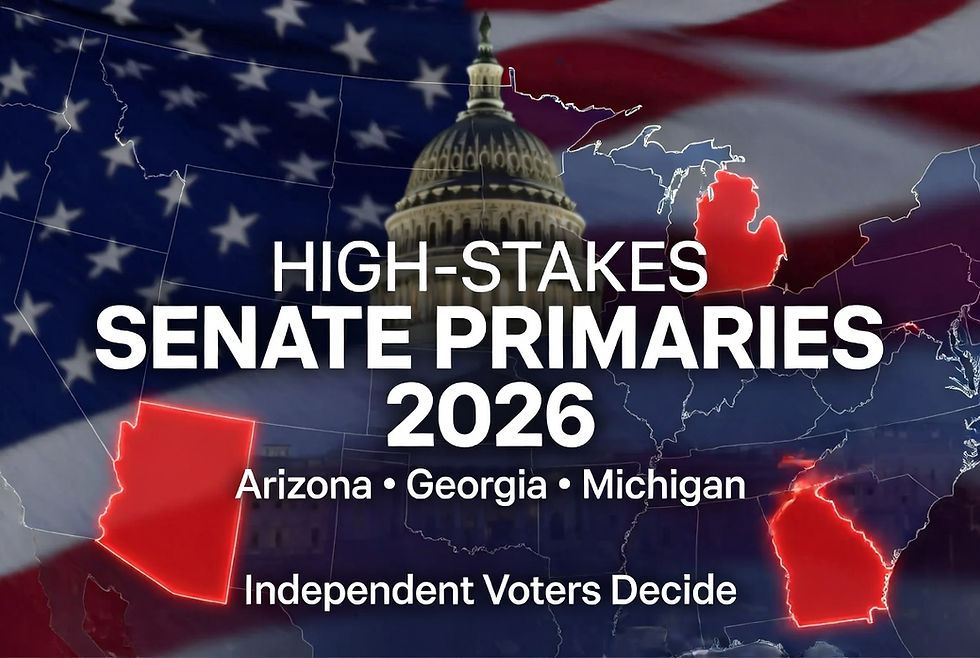
While every primary matters, these three Senate races are drawing massive national attention and money. In each one, Independent voters have real power to shape who reaches the November ballot and could help decide control of the Senate.
Republicans currently hold a 53–45 majority, with two Independents caucusing with Democrats, giving them an effective 47 seats. With 35 seats up this fall, Democrats need a net gain of four seats to flip the chamber. That makes these battlegrounds especially critical.
Here are the three contests Independents should watch most closely:
1. Arizona: The Semi-Closed August Wild Card
With Independent Sen. Kyrsten Sinema not seeking reelection, Arizona is one of the most closely watched open-seat races in the country. The primary is on July 21, 2026, under a semi-closed primary system.
Registered Independents and unaffiliated voters can participate by simply requesting either the Democratic or Republican ballot at the polling place or by mail. Because independents make up roughly a third of Arizona's electorate, the primary ballot they choose could decide the direction of this toss-up state.
The Matchup: On the Democratic side, Congressman Ruben Gallego is leading the charge, while the Republican primary features a fierce battle between Kari Lake and Pinal County Sheriff Mark Lamb. Because Independents represent roughly a third of Arizona's electorate, the party ballot you choose to walk away with this August will determine the entire direction of this toss-up state.
Latest Polling: Gallego leads both Lake and Lamb by 5–12 points in early general election surveys. The GOP primary remains competitive, with Lake holding a slight edge.
Top Issues: Border security and immigration, cost of living/inflation, water rights/drought, and economic growth.
Top Controversy: Kari Lake continues to draw heavy criticism for her 2022 election denial claims and refusal to concede, which many moderates and Independents see as a major general-election liability.
Total registered voters: ~4.34 million
Republicans: 35.5%
Democrats: 28.1%
Independents/Unaffiliated & Other: 34.5% (fastest-growing group)
2. Georgia: High-Stakes June Runoff
Democratic incumbent Sen. Jon Ossoff is seeking a second term in a state that has swung hard in recent elections. Georgia uses a fully open primary any registered Independent can vote in either party's contest.
If you are a Georgia Independent, you have a full legal right to cast a ballot in this June runoff and choose Ossoff's challenger even if you didn't vote in May.
The Matchup: While Ossoff sailed through his primary uncontested, the Republican side turned into an absolute battle royale on May 19. Because no GOP candidate crossed the 50% threshold, the race is heading to a high-stakes June 16 runoff between Congressman Mike Collins and former college football coach Derek Dooley.
Top Issues: Cost of living/inflation, jobs/economy, immigration, and public safety.
Top Controversy: Mike Collins fired a top campaign adviser after an inflammatory and vulgar social media post, highlighting the bitter tone of the GOP runoff.
Total registered voters: ~7.54 million
Democrats: ~43%
Republicans: ~27%
Independents/Other: ~30%
3. Michigan: The August Wild Card
This is a wide-open seat after longtime Democratic Sen. Gary Peters retired. Michigan's primary is set for August 4 under a fully open primary system, in which Independents choose one party's ballot in the voting booth.
Because Independents can cross over, their choices in August will heavily influence which candidates reach November.
The Matchup: The Democratic primary features a competitive three-way race between Rep. Haley Stevens, State Sen. Mallory McMorrow, and Dr. Abdul El-Sayed. Former Rep. Mike Rogers is the Republican frontrunner.
Democratic Primary: Abdul El-Sayed leads with 24–28% (many voters still undecided).
General Election: Rogers is in a statistical dead heat with the likely Democratic nominee.
Top Issues: Economy/affordability, health care costs, housing, and immigration.
Top Controversy: The Democratic primary has turned sharply negative, with candidates attacking each other over immigration policy and questions about Abdul El-Sayed's medical credentials.
Total registered voters: ~7.92 million
Democrats: ~53%
Republicans: ~30%
Independents/Other: ~17%
Final Thoughts
These three races show why primaries are so important for Independent voters. In low-turnout elections, your single vote carries outsized weight and can help elect more moderate, pragmatic candidates willing to work across the aisle.
Make your voice heard:
Make sure you're registered to vote
Mark your primary date on the calendar
Follow the candidates and key races
Follow us @IndTimesNews for daily updates and analysis

Independent Times News
Less Party. More Country.
A Newsroom Built for America's Largest Voting Bloc
Subscribe: → IndTimes.news (straight to your inbox)
Follow: @IndTimesNews (X, Instagram, TikTok, YouTube & more)
Podcast: Independent Times News (available on all platforms)
These are not the best of times, nor the worst, but these are undoubtedly Independent Times.


Comments