Special Elections Report Card: Democrats Show Surprising Strength in 2025–2026

Updated: Jul 20
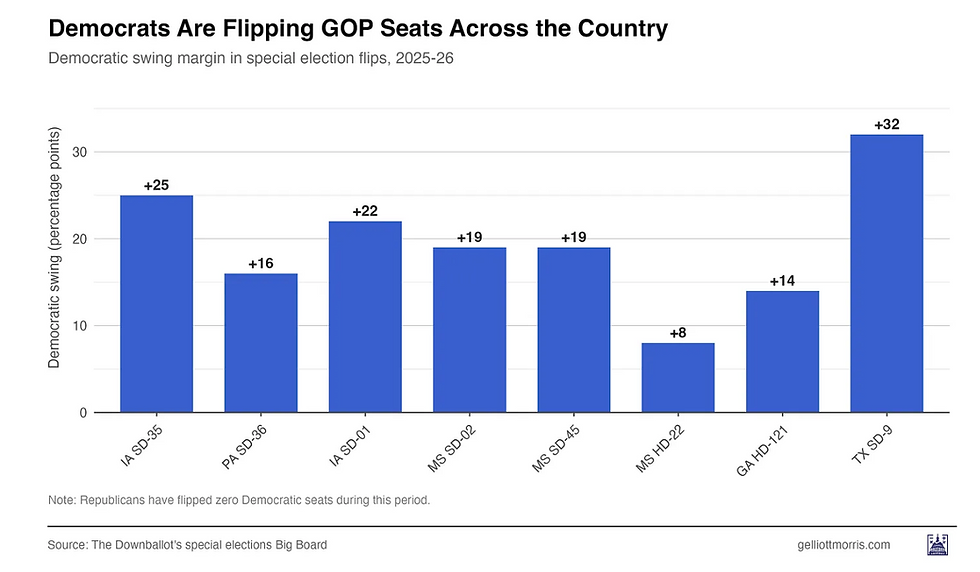
While the country focuses on the ongoing primary season, a quieter but telling story has been unfolding in special elections across the United States since President Trump returned to office.
The raw data shows just how widespread this trend is. In the 39 contested state legislative special elections held so far, Democrats ran ahead of their 2024 presidential baselines an impressive 34 times. On average, Democratic candidates are running about 10.4 points stronger than Kamala Harris did in these same districts just a year and a half ago.
In race after race, from state legislative districts to congressional vacancies, Democrats have consistently outperformed expectations. In many cases, they have run significantly ahead of the 2024 presidential baseline numbers, even in districts that strongly supported the Republican ticket.
The table below breaks down major federal and notable state special elections held so far across this cycle, showing exactly how the final margins shifted.
2025–2026 Special Election Scorecard
Race / District | Election Date | Winner | Special Election Margin | 2024 Presidential Margin | The Shift |
Texas State Senate (SD-9) | Jan 31, 2026 | Taylor Rehmet (D) | D+14.4 | R+17.4 | D+31.8 (FLIP) |
Florida State Senate (SD-14) | Mar 24, 2026 | Brian Nathan (D) | D+0.3 | R+11.5 | D+11.8 (FLIP) |
Florida State House (HD-87) | Mar 25, 2026 | Emily Gregory (D) | D+2.4 | R+8.2 | D+10.6 (FLIP) |
Arkansas State House (HD-70) | Mar 3, 2026 | Alex Holladay (D) | D+14.8 | R+6.2 | D+21.0 (FLIP) |
Virginia U.S. House (VA-11) | Sept 9, 2025 | J. Walkinshaw (D) | D+50.0 | D+34.0 | D+16.0 (Hold) |
Arizona U.S. House (AZ-7) | Sept 23, 2025 | A. Grijalva (D) | D+40.0 | D+22.0 | D+18.0 (Hold) |
Florida U.S. House (FL-1) | Apr 1, 2025 | Jimmy Patronis (R) | R+15.0 | R+37.0 | D+22.0 (Hold) |
Florida U.S. House (FL-6) | Apr 1, 2025 | Randy Fine (R) | R+14.0 | R+30.0 | D+16.0 (Hold) |
Georgia U.S. House (GA-14) | Mar 10, 2026 | Clayton Fuller (R) | R+12.0 | R+37.0 | D+25.0 (Hold) |
Tennessee U.S. House (TN-7) | Dec 2, 2025 | M. Van Epps (R) | R+9.0 | R+22.0 | D+13.0 (Hold) |
Note: Margins are approximate based on final certified results. Source: MultiState, Ballotpedia, and state election officials.
Upcoming 2026 U.S. House Special Elections
District U.S. House | Predecessor | Vacancy Date | Scheduled Election Date | Primary Status / Details |
Georgia 13th | David Scott (D) | April 22, 2026 | July 28, 2026 | Vacated due to death; Governor called special summer vote. |
California 1st | Doug LaMalfa (R) | Jan 6, 2026 | August 4, 2026 | Vacated due to death. |
California 14th | Eric Swalwell (D) | April 14, 2026 | August 18, 2026 | Vacated via resignation. |
Florida 20th | S. Cherfilus-McCormick (D) | April 21, 2026 | TBA | Vacated via resignation. |
Texas 23rd | Tony Gonzales (R) | April 14, 2026 | TBA | Vacated via resignation. |
Reading the Margins
Analysts tracking these contests note that Democrats have flipped multiple Republican-held state legislative seats so far, with no flips in the opposite direction. Even in deeply Republican areas where the GOP successfully defended congressional vacancies, the margins narrowed sharply.
Two standout examples highlight the trend. In Texas Senate District 9, Democrat Taylor Rehmet flipped a seat Donald Trump won by 17 points, winning by 14 points, a stunning 31-point swing toward Democrats. In Florida Senate District 14, Democrat Brian Nathan pulled off a razor-thin upset in a district Trump carried by 11 points, a seat long considered safely Republican.
Recent national polling helps explain what’s happening. Democrats currently lead Republicans by 6 to 8 points on the generic congressional ballot, while President Trump’s approval rating sits in the mid-to-high 30s, with disapproval in the high 50s. This mix of stronger Democratic numbers and softer support for President Trump appears to be driving the consistent Democratic overperformance in these special elections.
The pattern has repeated across dozens of races in Wisconsin, Michigan, Pennsylvania, Texas, and Georgia. Even in traditionally conservative areas, such as a notable Wisconsin judicial race, Democratic-backed candidates have posted surprisingly strong results.
Political observers caution that special elections usually feature low turnout and can exaggerate broader trends. Republicans argue these scattered results won’t necessarily predict the full 2026 midterms, when voter participation will be far higher. Still, the steady Democratic overperformance of roughly 10 points above the 2024 baseline has caught the attention of strategists on both sides.
For Independent Voters
These special elections offer an early and honest look at the national mood. They suggest that many voters, especially Independents, are unsettled with the current direction and are open to alternatives. As we head into the heart of the 2026 primary season, Independents have a real opportunity to influence which candidates ultimately make it onto the November ballot. In low-turnout races like these, the Independent vote carries extra weight and could help shape a more moderate, pragmatic Congress.

Independent Times News
Less Party. More Country.
A Newsroom Built for America's Largest Voting Bloc
Subscribe: → IndTimes.news (straight to your inbox)
Follow: @IndTimesNews (X, Instagram, TikTok, YouTube & more)
Podcast: Independent Times News (available on all platforms)
These are not the best of times, nor the worst, but these are undoubtedly Independent Times.


Comments