The National Governors Association: Bipartisan Progress in Action

Updated: Jul 20
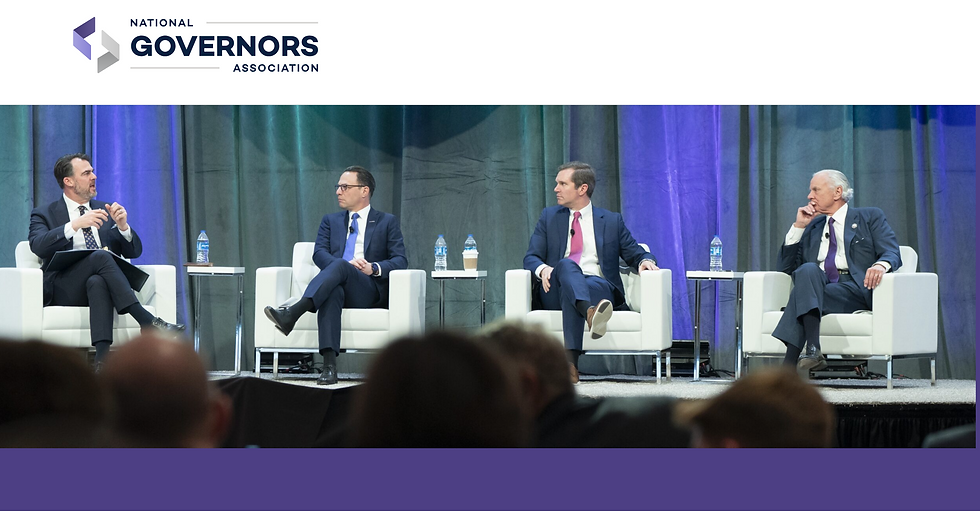
Cooperation Without the Cameras
Bipartisanship gets talked about a lot more than it gets practiced. One place it still happens, quietly and consistently, is the National Governors Association. Founded in 1908, the NGA brings together the governors of all 50 states plus the five U.S. territories, 55 members in total, from every corner of the political spectrum. No cable news hits, no viral moments, just governors comparing notes on what's working back home and borrowing each other's best ideas.
Who They Are and What They Stand For
Every sitting governor belongs, and the organization only takes positions by consensus. When the NGA speaks, it speaks for the states as a whole, not for one party's half of them. Leadership reinforces that balance: the chair and vice chair always come from opposite parties, and the roles rotate each year. Oklahoma Governor Kevin Stitt, a Republican, has held the chairmanship this past year, with Maryland Governor Wes Moore, a Democrat, serving as vice chair and set to succeed him. A Republican and a Democrat, sharing the wheel by design.
The mission itself is modest, almost unfashionably so: honest dialogue, shared best practices, policy innovation, and advocacy for state-led answers to national problems. Education, workforce development, infrastructure, health, economic opportunity, the unglamorous stuff that determines how people's lives actually go. Governors meet regularly, form task forces, run policy academies, and work with federal partners. Unlike most people arguing about policy, they're the ones who have to make it work on Monday morning.
Real Results Through Cooperation
The model has a track record. When COVID-19 hit, governors from both parties joined weekly coordination calls that often drew 40 to 45 leaders at once, aligning on health responses, testing, vaccines, and federal support. Whatever was happening in Washington, the states were talking to each other.
The cooperation didn't end with the pandemic:
Workforce and good jobs. Governors regularly make joint commitments to scale up programs with proven results. Oklahoma put $19 million in public money, backed by a major philanthropic partnership, toward connecting residents with high-demand careers in manufacturing, healthcare, and advanced industries. Maryland committed $25 million, plus additional support, to train and place thousands of workers in cybersecurity, IT, healthcare, and aerospace.
Educational breakthroughs. Colorado's universal free preschool program passed with broad support and now serves 43,000 children, saving the average family more than $6,100 a year. Oklahoma built workforce-oriented high schools where students can earn a pilot's license or a technical certificate before they graduate. Hawaii shrank its teacher shortage from 1,000 vacancies to roughly 100 through targeted recruitment. New Mexico invested in high-quality tutoring and saw achievement rise in math, reading, and science.
Infrastructure and permitting. A bipartisan working group of governors produced concrete recommendations for streamlining federal permitting on critical projects, cutting delays and costs without gutting environmental or safety review.
Youth mental health. Through dedicated policy academies, states including Alabama, Hawaii, Kentucky, New Jersey, Oklahoma, and Virginia built stronger partnerships across their agencies, secured new funding, and launched programs for young people, from school-based services to protections against harmful social media influences.
None of these is a partisan trophy. They're practical fixes that reach real families, workers, and communities, the kind of progress that shows up when leaders decide shared purpose beats point-scoring.
Why It Matters
Ask Americans what they want from their leaders and the answer rarely changes: work together, get things done. The NGA is one of the few institutions that treats that as a job description rather than a talking point. It filters out the noise, focuses on scalable solutions, and proves that some of the country's best ideas come from states experimenting and learning from one another.
Governors don't agree on everything, and they shouldn't. But within this association, they keep talking, keep listening, and keep moving forward on the issues that touch every American's life: good jobs, strong schools, safe communities, and real opportunity. That's what pragmatic leadership looks like. And it's proof that when governors from both parties sit down at the same table, the country moves forward.
Learn more about the National Governors Association, its current initiatives, and how your state's governor is involved at nga.org/about.

Independent Times News
Less Party. More Country.
A Newsroom Built for America's Largest Voting Bloc
Subscribe: → IndTimes.news (straight to your inbox)
Follow: @IndTimesNews (X, Instagram, TikTok, YouTube & more)
Podcast: Independent Times News (available on all platforms)
These are not the best of times, nor the worst, but these are undoubtedly Independent Times.


Comments