Part 4: Middle Ground For The SAVE America Act
- Independent Times News

- Apr 21
- 7 min read
Updated: Jul 20
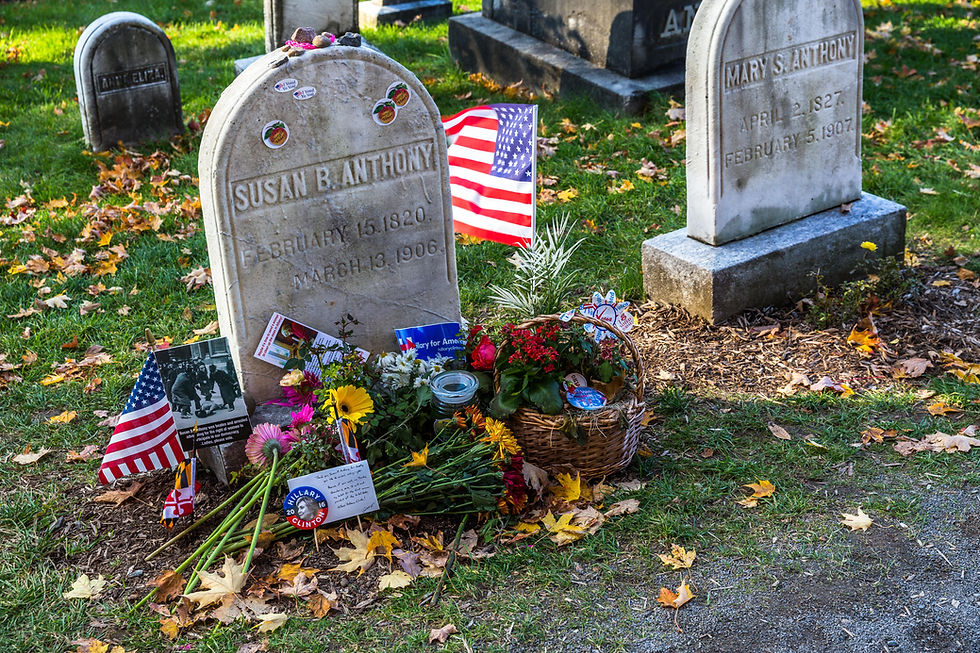
The Quiet Tradition at Susan B. Anthony’s Grave
Every election cycle, women and girls quietly visit Mount Hope Cemetery in Rochester, New York, leaving bright “I Voted” stickers on the headstone of Susan B. Anthony. In 1872, Anthony and fourteen other women registered and voted in the presidential election at a time when women lacked full voting rights under the law. Anthony was arrested, tried, and convicted of illegal voting. She refused to pay the fine, declaring she would “never pay a dollar of your unjust penalty.” She died in 1906, 14 years before the 19th Amendment granted women the right to vote in 1920.
Anthony’s story illustrates a recurring theme in American democracy: progress often demands persistence from those who may not live to witness the outcome. The stickers left at her grave today serve as quiet acknowledgments of that long arc, inspiring pride and hope in ongoing efforts for voting rights.
A Shift In Priorities
The debate over voting rights has long centered on expanding access. As we explored in depth in Part 2 of this series, the last major federal effort came in 1993 with the National Voter Registration Act, known as Motor Voter, which made it easier to register by linking the process to driver’s license applications and other government services.
Now, for the first time in decades, the federal government is moving in the opposite direction: from expanding access toward tightening security. That shift lies at the heart of the current fight over the SAVE America Act, which passed the House on February 11, 2026, by a vote of 218–213, and the executive order signed on March 31, 2026, directing federal agencies to share citizenship data with states.
Proponents view these measures as essential safeguards against inaccurate voter rolls. House Speaker Mike Johnson, after the House passage, stated:
“Proof of citizenship and photo ID to vote; everyone in the country understands the necessity of that and understands how simple it is and how important it is.”
Critics, however, argue that the changes could impose new burdens on eligible citizens. Senator Dick Durbin (D-IL) has been one of the most forceful opponents, stating:
“This legislation is voter suppression, plain and simple. It creates unnecessary hurdles that would disenfranchise millions of eligible voters, including married women who changed their names, seniors, students, and naturalized citizens whose records may not perfectly match federal databases.”
Independent voters, who now make up nearly half the electorate, often serve as a pragmatic counterweight to partisan intensity. Many view both parties with skepticism and seek election systems that are secure enough to inspire trust and accessible enough to encourage broad participation without constant litigation or eroded confidence in the outcome.
The Worst Parts of the Bill That Must Be Addressed
Independent reviews of the bill, including work by election attorney Jenny Cohn and CNN political commentator Van Jones, point to several provisions that could create real headaches for millions of eligible voters. These aren't small technical glitches. They're the main reasons many people say the bill, as written, could cause more problems than it solves.
Overly strict documentary proof of citizenship for registration or updates: The bill only accepts a narrow list of documents, like a passport, a special Real ID that actually says you're a citizen (only a few states issue those), or a photo ID paired with a matching birth certificate. Regular driver's licenses and most Real IDs don't count. Marriage certificates aren't accepted on their own. This hits tens of millions of married women whose birth certificates don't match their current name, along with seniors, students, rural voters, low-income folks, and naturalized citizens.
Mass submission of voter rolls to the DHS SAVE system: States have to turn over their entire voter lists for automated checks. There's a notice and a chance to prove citizenship before anyone gets removed, but SAVE has a track record of errors that flag actual citizens as problems. A bad purge could then push people into that strict new registration process all over again.
Asymmetric enforcement: Election officials can face fines and up to five years in prison for registering someone without the proper documents, even if that person is a legitimate citizen. But there's no real penalty on the other side for mistakes that wrongly knock eligible voters off the rolls.
Real-world precedents: When Kansas tried similar proof-of-citizenship rules, it blocked over 31,000 eligible citizens while catching only 39 noncitizens. In Arizona and New Hampshire, hundreds were turned away, including married women rejected because of name mismatches. Van Jones points to these examples as proof that the tradeoff just isn't worth it.
These flaws matter because they could create unnecessary barriers for millions of eligible citizens while only catching a tiny number of actual noncitizen voting cases. That's the core tension in this debate, and it becomes even more important when you look at the bigger picture of federal involvement in elections.
Trump's Call to "Nationalize" Elections
This debate is occurring amid a broader push from President Trump. In early February 2026, he told Dan Bongino on his podcast:
"The Republicans should say, We want to take over. We should take over the voting at least 15 places. The Republicans ought to nationalize the voting."
He specifically mentioned targeting places like Atlanta, Philadelphia, and Detroit. In the recent Atlantic article "The Founders Would Have Opposed 'Nationalizing' Elections," author Jeffrey Rosen reminds us why the Framers deliberately split authority. They gave Congress some power over the time, place, and manner of federal elections, but left primary control, especially voter qualifications and day-to-day administration, with the states.
Madison, Hamilton, and others designed this balance to prevent both federal overreach and partisan abuses by one party using Federal power against States run by the other party.
The SAVE America Act isn't a full federal takeover, but it fits into this broader conversation. It shifts more authority to federal databases, standards, and penalties, a move that fuels talk of nationalization. Rosen's piece shows that the Founders believed that divided power has generally worked better than concentrated control.
This bigger debate over federal power makes it even more important that we find a practical middle ground, one that strengthens election security without creating unnecessary barriers for eligible voters or straying too far from the Founders' balanced approach.
Paths Toward Compromise
If compromise is still possible, it probably won’t come from sweeping new restrictions. A more promising path lies in smarter, front-end verification that strengthens the system without placing heavy new burdens on ordinary citizens.
It is worth noting that, as currently written, the SAVE America Act does not require existing voters to provide additional documentary proof of citizenship if their name, address, and other records have remained unchanged. The new requirements would primarily apply when a voter moves, changes their last name, or otherwise updates their registration.
Several targeted amendments could strengthen the bill while reducing the risk of disenfranchising eligible citizens:
Automatic DMV–DHS Checks: Require or incentivize states, through federal funding, to run real-time checks against the Department of Homeland Security’s SAVE database whenever someone applies for or renews a driver’s license. This would catch potential issues at the point of contact rather than placing retroactive burdens on voters.
Expedited document assistance programs: Create short-term federal-state partnerships offering free or low-cost mobile units, online portals, and fee waivers to help seniors, students, low-income citizens, military families, and those with name changes obtain birth certificates or passports quickly.
Clear markings on non-citizen driver’s licenses: The 19 states plus Washington, D.C. that issue licenses to non-citizens should be required or incentivized to print bold, unmistakable language such as “NOT VALID FOR VOTING” or “NOT FOR VOTER REGISTRATION” in prominent text on these cards.
Clear markings on Social Security cards: Require the Social Security Administration to print visible warnings such as “NOT VALID FOR VOTING OR VOTER REGISTRATION” on cards issued to non-citizens. Since Social Security numbers and cards are commonly used during voter registration, this would add a simple, low-cost safeguard.
These adjustments would place more of the verification burden on government systems and agencies upfront, rather than on individual voters after the fact. They aim to strengthen election integrity while preserving the broad access gains achieved over more than a century.
Where the Bill Stands Now
The SAVE America Act has cleared one major hurdle but faces a steep climb in the Senate. As of late April 2026, the legislation remains stalled. Republicans hold a 53-seat majority, but Democrats have maintained a filibuster, and recent cloture votes have fallen short of the 60 votes needed to advance the bill.
Senate Majority Leader John Thune has acknowledged that the votes for passage are not currently there, and there is little indication of bipartisan support or willingness to alter Senate rules to force the measure forward. With the 2026 midterms now just months away, the window for enacting such a significant change to federal election law is narrowing. The bill’s future appears uncertain at best, caught between strong Republican backing and determined Democratic opposition, with Independents watching closely to see whether any compromise can emerge before the election season intensifies.
The Enduring Challenge
The real test of any election reform is whether it restores confidence that the final count reflects the will of eligible citizens, not whether it satisfies one party's base.
That balance between security and openness is what the debates over the SAVE America Act and the 2026 midterms ultimately turn on. Broad majorities of Americans (83% in recent Pew polling) support requiring photo ID to vote. The challenge is achieving that security while avoiding new barriers for eligible citizens.
Pushing major changes this close to the midterms risks confusion at the polls and extra strain on states. As Sen. Jack Reed warned, rushed changes could create "mass confusion" right as primaries are underway.
Independent voters are well-positioned to push back: contact your representatives and call for careful implementation, better front-end safeguards, and enough time for states to adapt without chaos.
Susan B. Anthony never lived to see women vote, yet her persistence helped make it possible. In the same spirit, building trustworthy elections requires protecting ballot integrity and preserving access not through polarization, but through careful, incremental reform.

Independent Times News
Less Party. More Country.
A Newsroom Built for America's Largest Voting Bloc
Subscribe: → IndTimes.news (straight to your inbox)
Follow: @IndTimesNews (X, Instagram, TikTok, YouTube & more)
Podcast: Independent Times News (available on all platforms)
These are not the best of times, nor the worst, but these are undoubtedly Independent Times.


Comments