The Independent Voter and the Spirit of Reform
- Independent Times News

- Jan 28
- 7 min read
Updated: Jul 20
If you feel like the game is rigged, the economy is unstable, and the two-party system is a closed loop, you aren't alone, and you aren't the first. In 1892, a group of outsiders looked at a Gilded America and decided to rewrite the political playbook. Today, as 45% of Americans identify as Independent, we aren't just watching history repeat. We’re watching it rhyme. Here's how a forgotten movement of farmers and laborers wrote the blueprint for the modern Independent voter, and why their ideas and strategy are exactly what we need today.
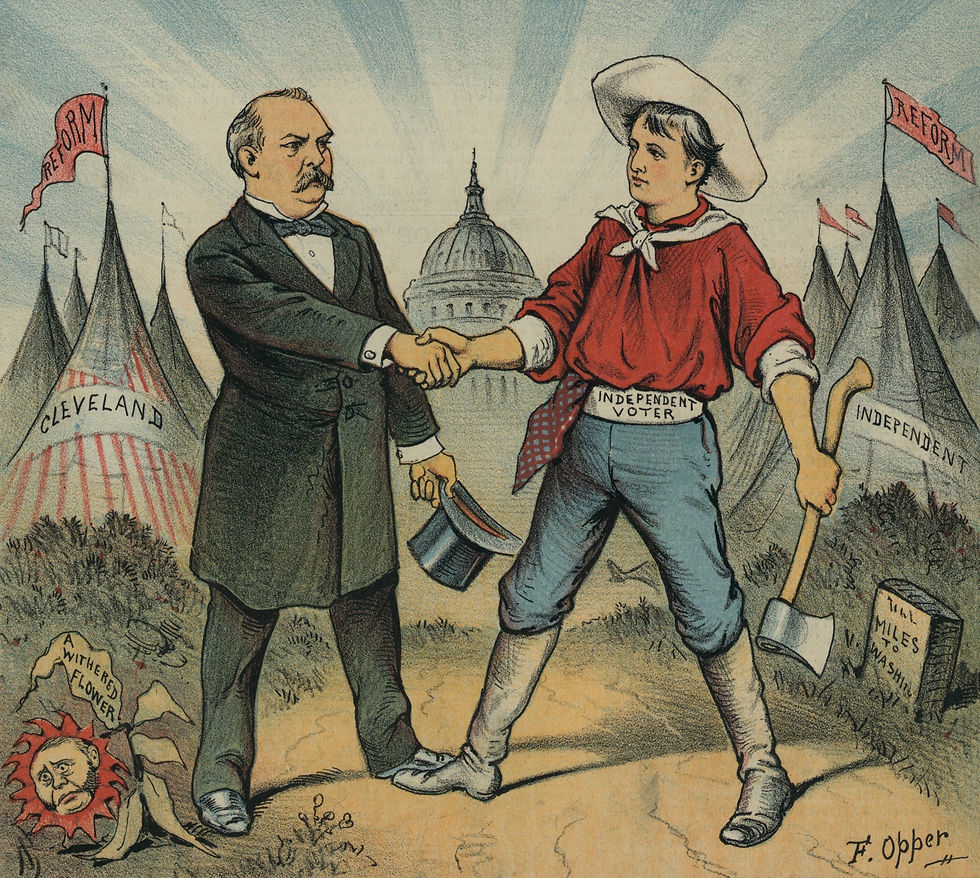
Frederick Burr Opper, Puck magazine, c. 1884 | Image: Shutterstock
Published February 27, 2026
A Nation on the Verge of Ruin
To understand where the independent movement may be headed, it helps to look back to a moment when the American Dream felt just as fragile as it does today.
In 1892, Ignatius Donnelly, a farmer, reformer, and architect of the Populist Party’s Omaha Platform, stood before a Nebraska convention and delivered a warning that refuses to age. His words painted a grim portrait of a nation on the brink:
"We meet in the midst of a nation brought to the verge of moral, political, and material ruin. Corruption dominates the ballot box, the Legislatures, the Congress…. The people are demoralized... business prostrated, homes covered with mortgages, labor impoverished, and the land concentrating in the hands of capitalists... From the same prolific womb of governmental injustice we breed the two great classes—tramps and millionaires."
Donnelly’s reputation as a reformer was already well established by 1892. His novel Caesar’s Column (1890) imagined a dystopian United States in 1988, ruled by a ruthless financial oligarchy and an abject working class reduced to servitude. The book presciently anticipated technologies such as radio and television, but it was its grim depiction of industrial warfare and poison gas that resonated most.
By showing the lengths to which an entrenched elite might go to maintain power, Donnelly amplified his standing among farmers and laborers who already felt the weight of corporate overreach. It was in this context that Donnelly helped found the Populist Party and drafted key elements of its Omaha Platform.
Donnelly wasn’t writing for a 2026 news cycle, yet his description of a nation on the verge of “moral, political, and material ruin” carries striking echoes today.
This modern resonance is reflected in a January 2026 Emerson College National Poll, which found that 56% of Americans believe the country is headed in the wrong direction. While the Populists of the 1890s fought railroad and banking monopolies that controlled their livelihoods, today’s voters confront a new set of gatekeepers: Big Tech and Big Pharma. The players and technologies have changed, but the underlying suspicion persists that the system still feels stacked against the average American.
This struggle for a responsive and fair government is a recurring theme in the American story. While the machinery of power takes different shapes in every era, the core conflict remains the same. As Voltaire observed, "History never repeats itself; man always does." The patterns of entrenched influence that once defined France’s ancien régime eventually crossed the Atlantic, resurfacing in a new form during the American Gilded Age.
A System Divided by Gold and Greed
In 1873, Mark Twain and Charles Dudley Warner co-authored The Gilded Age: A Tale of Today. The title was deliberately ironic: they were not describing an era of solid gold, but rather a cheap base metal coated with a thin, glittering layer of gold leaf. What they called a “Tale of Today” in the 1870s remains strikingly relevant in 2026. Beneath the surface of economic growth and concentrated wealth often lies a familiar pattern of systemic pressures that disproportionately burden ordinary Americans while enriching a narrow elite.
The Gilded Age (1870-1900) appeared prosperous on the surface, with booming industries and immense fortunes concentrated in the hands of a few elite Robber barons. Beneath that sheen lay a severe economic crisis driven by monetary contraction, falling prices, and structural pressures that hit ordinary Americans hardest.
The central trigger was a currency crunch. In an effort to align the U.S. economy with European standards, Congress adopted the gold standard through the Coinage Act of 1873. The act halted the free minting of silver dollars. It also ended the government’s obligation to accept silver bullion at a fixed ratio, sharply reducing the money supply just as population and economic activity were rapidly expanding.
This policy was more than a technical adjustment for farmers and laborers; it was a devastating trap. It triggered a deflationary spiral making money increasingly scarce. As the value of a dollar rose, the price of a bushel of wheat fell, yet the farmer's debt remained fixed. To pay back a $100 loan, a farmer suddenly had to produce twice as much corn as they did when they first borrowed the money. The result was a massive, structural transfer of wealth from rural debtors to the East's creditors and bankers.
Farmers were simultaneously squeezed by high freight rates and storage fees imposed by railroad monopolies, as well as by restrictive credit terms from banks. In the cities, parallel pressures produced widespread labor instability: long hours, stagnant wages, and the ever-present risk of unemployment.
These mounting strains culminated in the Panic of 1893, one of the deepest depressions in American history. A wave of bank failures and business collapses left roughly 18–20 percent of the workforce unemployed at the peak. Trust in the system evaporated as both major parties appeared beholden to corporate titans while remaining unresponsive to the hardship of farmers, workers, and small producers.
The era became one of profound regional and class division. Southern sharecroppers, Western miners, and Midwestern homesteaders increasingly felt politically abandoned and economically trapped.
The Rise of the People’s Party
Yet a spark of unity ignited in this darkness. This hope began with the Farmers' Alliances, grassroots organizations founded in the 1870s to combat the crop-lien system's economic stranglehold. What started as local groups of neighbors helping one another eventually evolved into a much broader movement. Visionaries like Henry George and Edward Bellamy inspired diverse groups of rugged farmers, urban laborers, and middle-class reformers to set aside regional and occupational rifts to form the People's Party, also known as the Populist Party, in 1892.
Meeting in Omaha, Nebraska, they crafted the revolutionary Omaha Platform with bold demands that aimed directly at the existing systems of power. Their plan for financial reform addressed the Coinage Act of 1873 by calling for free coinage of silver to expand the money supply, reversing the deflationary spiral that had made their debts impossible to pay.
They also demanded government regulation of railroads to stop price gouging. They fought for political empowerment through a graduated income tax, the direct election of senators, and an eight-hour workday for laborers. The Omaha Platform was more than just a list of policies because it represented a coalition of independents breaking free from the two-party stranglehold. It was built on mutual trust in a shared struggle against corruption. Leaders like Ignatius Donnelly and Mary Elizabeth Lease urged farmers to "raise less corn and more hell," forging a grassroots bond that the major parties could no longer ignore.

From Third-Party Defiance to Lasting Reform
During this era, a young New York politician, Theodore Roosevelt, was rising through the Republican ranks. Although Roosevelt remained mainly on the sidelines of the Populist surge, their influence and power were impossible to ignore. Roosevelt viewed radical agrarian demands, such as free silver and government ownership of railroads, as potentially destabilizing. Many leading Progressives, including Roosevelt, were vocal critics of Populism's more extreme elements, preferring measured reform over revolutionary upheaval. Yet, the third-party challenge of 1892 laid crucial groundwork; James B. Weaver garnered over a million votes and won four states under the slogan, "Equal rights to all, special privileges to none."
Despite setbacks, the Populists pressed on, and their ideas refused to die. By the early 1900s, Roosevelt ascended to the presidency after McKinley’s assassination in 1901, and he eventually embraced many of the same core reforms the Populists had championed. Roosevelt advanced trust-busting to curb corporate monopolies along with railroad regulation and consumer protections. His Square Deal promised fairness for workers, farmers, and the public against entrenched power.
While Roosevelt never ran as a pure third-party candidate until his 1912 Progressive Bull Moose bid, his administration helped institutionalize the changes the 1890s independents had fought for. This foreshadowed constitutional amendments, such as the direct election of senators, the income tax, and the regulatory framework that shaped the 20th century.
The 1896 fusion with the Democratic Party behind William Jennings Bryan brought short-term visibility but ultimately signaled the end of the People’s Party as a stand-alone organization. For today’s independent voters, this history underscores a vital truth: political ideas can win even when the parties that champion them do not. The "losing" platform of 1892 eventually became the law of the land:
Omaha Platform Demand (1892) | Resulting Reform |
Direct Election of Senators | 17th Amendment (1913) |
Graduated Income Tax | 16th Amendment (1913) |
8-Hour Work Day | Fair Labor Standards Act (1938) |
Postal Savings Banks | Postal Savings System (1910) |
Regulation of Monopolies | Clayton Antitrust Act (1914) |
The Populists of the 1890s proved that trust built through shared purpose and persistent action can challenge the powerful and heal deep divisions. When people unite under a shared struggle, they don’t need a major party’s permission to reshape the country.
For the independent movement to maintain long-term leverage in 2026, its success hinges on resisting absorption by the major parties and maintaining a distinct political identity.

President Theodore Roosevelt at Lincoln's Tomb, Springfield, Ill, 1903
Image Courtesy of The Library of Congress
The Power of the Persistent Outsider
The arc from 1892 to the reforms of the early 20th century reveals a recurring pattern: third-party movements rarely capture the presidency, but they can significantly shift the national conversation and compel the major parties to respond. The Populists did not win the White House. Yet, their pressure helped produce railroad regulation (Clayton Antitrust Act, 1914), the direct election of senators (17th Amendment, 1913), the federal income tax (16th Amendment, 1913), and the broader regulatory framework that defined the Progressive Era (1897-1920).
In 2026, the Independent is no longer a political outlier; it is the plurality. With recent data showing that a record 45% of Americans (Gallup 2025) now shun major party labels, the frustration of the 1890s has found a new, digital-age echo. Whether this growing bloc can exert comparable influence remains an open question.
The Populists of the 1890s showed that determined outsiders can move a resistant system forward. Today’s independent voters occupy a similar position, not as a traditional third party, but as a broad, decentralized force capable of reshaping the terms of debate, provided they sustain focus on shared goals rather than partisan loyalty.
The question now is whether this moment will produce another chapter in the long American story of reform-minded outsiders who, by refusing to accept the status quo, help write a fairer next page.

Independent Times News
Less Party. More Country.
A Newsroom Built for America's Largest Voting Bloc
Subscribe: → IndTimes.news (straight to your inbox)
Follow: @IndTimesNews (X, Instagram, TikTok, YouTube & more)
Podcast: Independent Times News (available on all platforms)
These are not the best of times, nor the worst, but these are undoubtedly Independent Times.


Comments